
Supranational humanitarian organisations are, as the bold motto of our own society suggests, timeless, ubiquitous, and essential. Even so, the timelessness and ubiquity remarked upon seem to be of but apparent nature, their character instead innate to the time and place that direct the organisations’ energies. The latter both reflect and correct the modernity, thus providing a remedy to its intrinsic afflictions. The International College of Dentists is no exception, with such aspiration woven into the very gist of its establishment in 1920 by Dr Louis Ottofy and Dr Tsurukichi Okumura. It is precisely the spirit of the College’s motto, “Recognising Service as well as the Opportunity to Serve”, that best encapsulates the overarching goal of our organisation – to provide the dentists with an opportunity to seek solutions to contemporary challenges as well as to perfect their craft.
The turmoil of the expired ideology in the 1990s finally brought the decades-long international isolation of Eastern Europe to its end, providing a backdrop against which the European Section of the ICD shored up its efforts to reintegrate dentists in the region that might have been short of professional recognition, but by no means of their actual talent and highest ethical standards. To that goal, the ICD founded a dedicated Committee for Expansion into Eastern European Countries, with one of its members being the then-Regent of the Greek District, Professor Aris-Petros Tripodakis. Merely a year after the Committee’s institution, Professor Tripodakis, an exemplary prosthodontist, put forward a proposal that his Slovenian colleague, likewise an outstanding clinical prosthodontist and researcher at the University of Ljubljana, Slovenia, Professor Ljubo Marion be inducted into the ICD. The motion having been met with approval, Professor Marion became one of the first Eastern European ICD fellows.
Clinical excellence, perceptive research drive, unfaltering moral principles that guided Professor Marion’s work both as a dentist and Rotarian, and contagious exultation over life’s pleasures, including golf, profoundly aided him in his ICD endeavours. The crowning jewel among them is of course none other than the 2008 establishment of the supranational District D14 – District Central and Eastern Europe, for which he at pace garnered sufficient support in the ICD European Section. In the capacity of the Regent of D14, Professor Marion, MICD masterfully steered the District in question until 2018, his tenure marked by a surge in membership among dentists spanning a multitude of countries. District D14 comprised Fellows from Estonia, Latvia, Lithuania, Poland, Czechia, Slovakia, Hungary, Slovenia, Ukraine, Moldova, Croatia, Bosnia and Herzegovina, Serbia, North Macedonia, Romania, Bulgaria, and Georgia. Managing such an extensive network of dentists certainly proved to be a formidable feat, but nevertheless one Professor Marion commendably navigated owing to his stellar academic reputation and virtuous character, as well as selfless help extended by Vice-Regents of individual states. The pinnacle of Professor Marion’s Regency was his presidency of the ICD European Section in 2014, along with that year’s Annual Meeting of the ICD European Section in Ljubljana, an event many European Fellows to this day cherish by virtue of its superb organisation and pleasant ambience.
In 2018, Professor Tomislav Jukič of Slovenia succeeded Professor Marion as the Regent of the D14. Throughout his tenure, Professor Jukič faithfully continued the mission envisaged by his predecessor and so greatly contributed to the spread of ICD ideas among Eastern European states. Due to substantial increase in number of Fellows in Ukraine, Estonia, Latvia, Lithuania, Poland, and Georgia, the year 2019 saw major reorganisation within the District D14 and establishment of a new District D15 under Regency of Dr Serhiy Radlinsky of Ukraine, which covered Central and Northern Europe. The D14, meanwhile, retained its supervision over Central and Southern Europe, a revision reflected in its new name. Professor Jukič played a crucial role in this reform, which has since proven to be a most fruitful one, with the D15 gaining numerous fellows in the years since and two new Districts – D16 Georgia under Regency of Professor Marine Mamaladze and D18 Baltic States under Regency of Dr Aiva Pakule – seceding from it in 2024 and 2025, respectively.
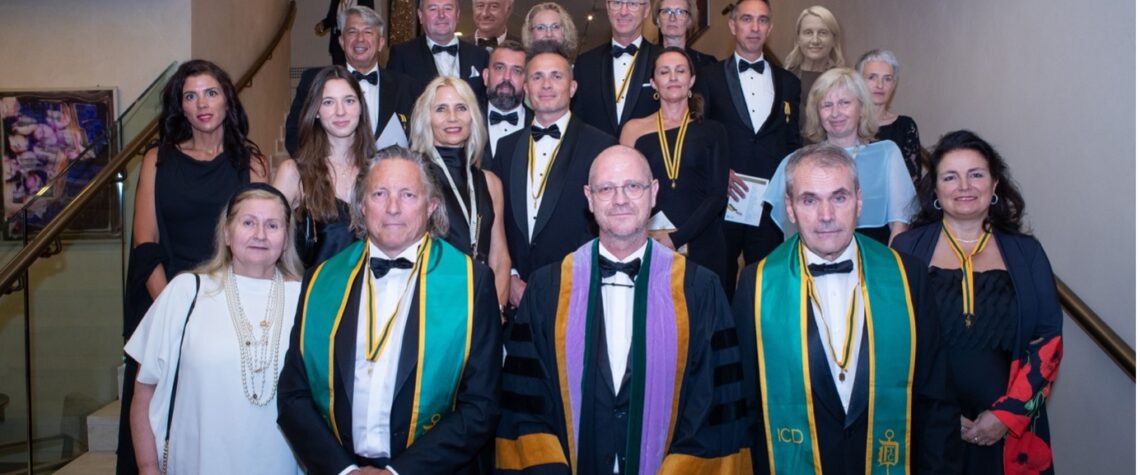
The Regency over D14 Central and Southern Europe was assumed by Dr Andrea Nasser in 2022, followed by Professor Norina Forma of Romania a year later. During the latter’s tenure, D14 saw the membership particularly increase in Romania, Bulgaria, and Albania, but also in Slovenia, an impulse that encouraged Slovenian Vice-Regent Professor Maja Ovsenik to formally present a proposal for establishment of an independent Slovenian District at the 2024 BORM in Limassol, Cyprus. Her motion was decisively assisted by D14 Regent Professor Forna, D14 Past-Regent Professor Jukič, ICD European Section Registrar Professor Mauro Labanca, and ICD European Section Past-President Walter van Driel. The proposal was endorsed at 2025 Winter BORM in Munich and the independent Slovenian District D17, presided over by Regent Dr Rok Jurič, for the first time inducted new Slovenian fellows at the 2026 Annual Meeting of the ICD European Section in Milan.
The path traversed from the outset of the idea of an independent Slovenian District, brought forth at the 2014 Autumn Meeting of the Slovenian ICD Fellows, to its fruition was therefore one of lengthy nature. Nevertheless, twenty-one years after the induction of the first Slovenian Fellow Professor Marion, MICD, and seventy years after the first meeting of the ICD European Section in London in 1956, Slovenia can at last claim to have been instituted among the full-fledged, independent member States of this esteemed dental organisation. Bearing in mind such privilege, Slovenian Fellows have taken upon themselves the obligation to perpetuate the five Core Values of the ICD, namely Leadership, Humanitarianism, Recognition, Education, and Professional Relations, as defining principles of professional conduct among Slovenian dentists.
In 2026, District D17 comprises 26 Fellows, 22 among them are active, 3 retired, and one Life Member (Professor Marion). From the outset, Fellows have been advocating for equal representation of all dental specialties practiced in Slovenia, resulting in roughly equivalent number of prosthodontists, periodontists, orthodontists, endodontists, paediatric dentists, oral and maxillofacial surgeons, and general dentists, who are predominant. Slovenian Fellows hail from across the country, thus affirming nationwide representation of dentists in the ICD. Furthermore, one half of Fellows work in private practices and the other half in public health facilities. Importantly, such a representative sample of Slovenian Fellows encouraged the leadership of the District to pursue robust ties with Slovenian academic establishments, particularly so as both Education and Professional Relations find themselves enumerated among the Core Values of the ICD. In consequence, all heads of dental departments at the Faculty of Medicine at the University of Ljubljana double as ICD Fellows. Recent formation of a new dental medicine programme at the University of Maribor further extended the circle of prospect Fellows, the fact mirrored in modest, but steady increase in membership, with one to three inductees promoted into Fellows on an annual basis.
Annual meetings of the Slovenian District take place in early autumn and are customarily very well attended, which indicates strong bonds and mutual affection amongst Fellows. The meeting is routinely merged with professional get-together of one of dental sections of Slovenian Medical Association, thus further reinforcing the note of the ICD among Slovenian dentists.
Slovenian District diligently recognises the importance the ICD ascribes to humanitarianism, its Fellows contributing their means to the cause to the best of their ability. Numerous Fellows partake in various humanitarian organisations, Rotary International, Lions International, or Caritas Internationalis. Furthermore, Slovenian Fellows actively participated in the establishment of dental medicine programme at the Faculty of Medicine at the University of Osijek, Croatia, as well as making and endorsement of Endodontocomix, the first comic strip concerned exclusively with endodontic treatment. The latter is noteworthy as it endeavours to familiarise the general population with dentists’ work and promote the impact of preventive care on oral health. On top of that, Slovenian Fellows have recently engaged in various forms of assistance to humanitarian project Earth Medicine for rehabilitation at the migrant centre on the island of Lesbos, Greece.
In conclusion, therefore, it is perfectly due to maintain that the establishment of D17 reaffirmed Slovenian dentists’ rightful place on the map of international dental professionalism. Looking back at the negotiated trail, one can contentedly observe that every step Slovenian Fellows took admitted their unwavering commitment to Core Values of the ICD – Leadership, Humanitarianism, Recognition, Education, and Professional Relations. I can thereby assess with considerable joy that the outlook of the ICD in Slovenia is bright, its Fellows eagerly anticipating opportunities to shape prospective time with faithful regard for the ICD Motto “Recognising Service as well as the Opportunity to Serve”.